
Pulaski County Court Records After Arrest
The Pulaski County arrest path starts with legal authority for custody, then booking at the Pulaski County Regional Detention Facility or short-term municipal holding before transfer. The Pulaski County Sheriff's Office, led by Sheriff Eric S. Higgins, says jail intake must have documented legal authority, such as an arrest warrant, court order, commitment, or other lawful custody paper. The booking side records name, demographics, booking photo when available, arrest date, held-for agency, and hold reasons. That is not the same thing as the court record after arrest.
After arrest, the Pulaski and Perry County prosecutor describes an Initial Appearance before a District Court judge. At that hearing, the defendant is advised of charges and bond is addressed. The case then reaches the prosecutor's file-decision stage, where the Sixth Judicial District Office of the Prosecuting Attorney reviews evidence and decides whether formal charges will be brought. Those filed charges are the court record to follow in Search ARCourts and through the Pulaski Circuit and County Clerk. Custody and booking details are better handled through Pulaski County jail inmate records, while booking photos belong with Pulaski County jail mugshots.
Find Pulaski County Court Records After Arrest
Search ARCourts is the statewide public court case search used for Arkansas courts that participate in the Contexte system. The Arkansas Judiciary says public case information may include parties, judge, filings, charges and dispositions, future events, judgments, and document links for some public court records. Search ARCourts is the right place to begin once Pulaski County court records after arrest have reached the filed-case stage. It is not the jail roster, and it is not a mugshot gallery.
- Open Search ARCourts and use the participant search when starting with a defendant name.
- Enter the first, middle, or last name as available. A case number can narrow the result if it is already known.
- Open the matching Pulaski County case and review the parties, filings, future events, charge entries, and disposition fields that are public.
- Check each charge rather than relying on the first line. Booking charges can differ from the prosecutor's filed charges.
- For an official or certified court record, contact the clerk of the court instead of relying on a printed portal view.
The Judiciary warns that printed Search ARCourts material is not an official court record. Official Pulaski County court records and certified copies come from the Pulaski County Circuit and County Clerk. The clerk lists its main office at 401 W. Markham St., Suite 100, Little Rock, AR 72201, with Court Clerks in Room 121 and a court-clerk phone line at 501-340-8431. The clerk site footer lists Monday through Friday, 8 a.m. to 5 p.m. hours.
| Search ARCourts Field | Type | Required | Use in a Pulaski Case Search |
|---|---|---|---|
| Search by... | Dropdown | Unspecified | Participants was visible during research; Cases is also identified in navigation material. |
| First Name | Text | Unspecified | Use when the defendant's full name is known. |
| Middle Name | Text | Unspecified | Helpful for common names in Pulaski County criminal cases. |
| Last Name | Text | Unspecified | The most useful starting field for a participant search. |
| Organization or Case Description | Text | Unspecified | Used where an organization or case description is the search key. |
| Advanced filters | Button | No | Refines the public court records search when too many results return. |
Arrest to Pulaski Court Filing
The Pulaski prosecutor's criminal-case material gives the local sequence: arrest, Initial Appearance, file decision, diversion screening where appropriate, Circuit Court plea and arraignment, omnibus hearing, trial, and sentencing. An arrest may come from officer-observed probable cause or from an arrest warrant based on evidence presented to a judge. At the first appearance, a District Court judge advises the person of charges and addresses bond. After that, prosecutors decide if formal charges should be filed and what those charges should be.
The practical flow is: arrest to booking to first appearance to prosecutor review to charging document to court case. A person can be shown on the PCSO Zuercher roster before a formal Pulaski court case is visible online. A case can also be declined, amended, reduced, or diverted. That is why Pulaski County court records after a jail arrest should be checked after the initial booking record, not assumed from the booking charge alone.
The Sixth Judicial District Office of the Prosecuting Attorney is the prosecution office for Pulaski and Perry Counties. Its main office is at 224 South Spring St., Little Rock, AR 72201, and the main phone is 501-340-8000. The office states that it serves the largest judicial district in Arkansas and includes felony, district, juvenile, domestic violence, drug, general jurisdiction, and specialty court work.
The Arkansas public court portal is shown in the captured Search ARCourts source screen.
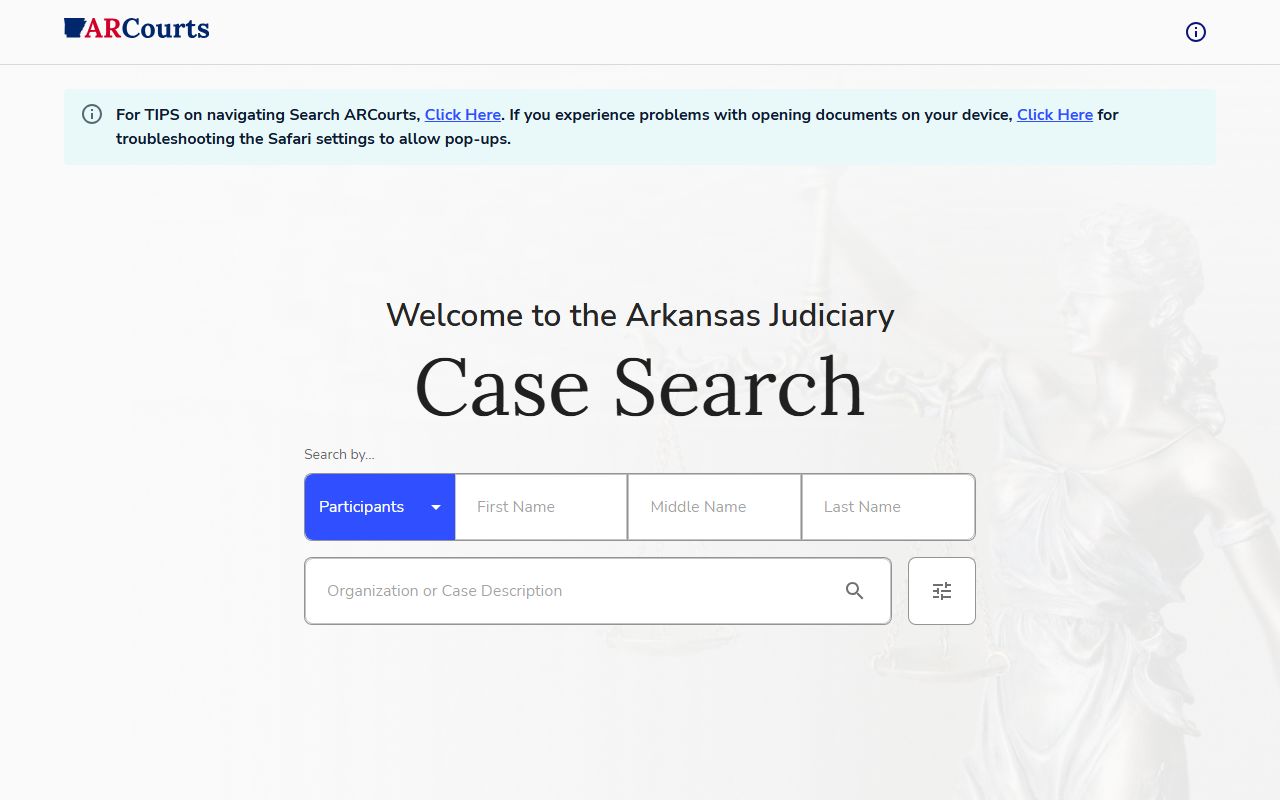
That screen is the public starting point for filed case information, while certified Pulaski County court records still come from the clerk.
Pulaski County Charging Documents
Formal Pulaski County court records after arrest are built around a charging document. The research file does not identify one single local form for every case, so the safest way to read the court record is to identify the filing type shown in the case. A complaint, information, or indictment can all start or define a criminal charge. The key point is that the prosecutor's filed charge may be different from the offense text seen in the jail hold reasons.
| Document | Who Uses It | What It Does | Reader Caution |
|---|---|---|---|
| Complaint | Law enforcement or prosecutor process, depending on case type | States alleged facts or charges and may support arrest or court action. | Can precede later formal filing or amendment. |
| Information | Prosecutor | Charges a defendant in court after prosecutor review. | Common in felony practice and may differ from booking text. |
| Indictment | Grand jury | Accuses a defendant after grand-jury action. | Less common than prosecutor filing, but it is still a court charging document. |
Search ARCourts may show charge entries, filings, events, and dispositions that help identify the current court posture. For the official version, the clerk's certified record controls. Administrative Order 19 can keep some information out of the online view, especially when the record is juvenile, sealed, confidential, or otherwise protected by court rule.
Pulaski Charge Status Terms
Charge status is where Pulaski County court records after arrest often differ from the jail roster. The roster can show warrant labels, arrest dates, bond text, court divisions, and hold reasons. Prosecutors may later file different charges, decline a case for insufficient evidence, add a charge, amend a charge, reduce a charge, or dismiss a charge. Readers should compare the filed court case with every hold reason instead of treating a booking line as the final case outcome.
| Status | Plain Meaning | Where It May Appear |
|---|---|---|
| Pending | The charge is open and has not reached final disposition. | Search ARCourts events, charge list, or future hearing entries. |
| Amended | The filed charge was changed after filing. | Court filings or updated charge entries. |
| Reduced | The charge moved to a lesser offense or lower level. | Plea, amended information, or disposition fields. |
| Dismissed | The court case or charge did not proceed to conviction. | Disposition or order entry. |
| Nolle prosequi | The prosecutor chose not to proceed on that charge. | Disposition or prosecutor filing. |
| Declined | The prosecutor did not file formal charges after review. | May not appear as a public filed case if no case opens. |
Pulaski Bond After Arrest
Bond is addressed early in the Pulaski County court records after arrest pathway. The prosecutor cites Arkansas Rule of Criminal Procedure 9.2 and explains that the judicial officer first considers whether non-financial conditions can reasonably ensure the defendant's appearance. Money bail is considered only if non-financial terms are not enough. Bond factors listed by the prosecutor include community ties, employment and financial resources, criminal history, prior response to court process, charge seriousness, and risk to public safety or the administration of justice.
Local posting and status questions can involve more than one office. PCSO says its Judicial Division processes cash bonds from the Pulaski County Regional Detention Facility. The Judicial Division is at 401 West Markham in the basement of the Pulaski County Courthouse, with phone 501-340-8450. PCSO Records/Warrants is another status channel at 501-340-6625, and the detention facility line is 501-340-7001.
| Bond Type | Pulaski/Arkansas Meaning | Custody Caution |
|---|---|---|
| Surety bond | A bond posted through a surety or bail-bond arrangement. | Another no-bond hold can still block release. |
| Cash bond | Money posted directly as required by the bond order. | PCSO Judicial Division processes cash bonds from PCRDF. |
| Own recognizance | Release based on a promise to appear, without a money bond. | Other court or agency holds must still be checked. |
| No bond | Payment is not available for that hold at that time. | Common with some warrants, revocations, or court holds. |
| See first charge | Related holds use the bond treatment shown on the first charge. | Read every hold reason before assuming release terms. |
Pulaski Warrants and Court Records
No official PCSO public active-warrant search portal was found in the research pass. For warrant questions, PCSO identifies Records/Warrants at 501-340-6625 and the Judicial Division at 501-340-8450. The Judicial Division serves and enforces body attachments, forthwith orders, child custody orders, domestic abuse orders, and other court papers, and it performs bailiff and civil-process duties for Pulaski County courts and Arkansas appellate courts.
Warrants connect to court records after a Pulaski County arrest in two ways. First, an arrest can occur after evidence is presented to a judge and a warrant is issued. Second, once the warrant is served and the person is booked, the Zuercher roster may show warrant labels in hold reasons. Research samples included labels such as affidavit felony, failure to appear, probation revocation, and bench warrant. A pending court case may show related events in Search ARCourts, but certified warrant and case records come from the relevant clerk or court.
Warrant note: A warrant line on the jail roster is a custody clue. It is not the same thing as a certified Pulaski County court record.
Pulaski Charges vs Convictions
An arrest charge is an accusation, not a conviction. Pulaski County court records after arrest may show that a case is pending, amended, diverted, dismissed, resolved by plea, tried, or sentenced. The prosecutor's page identifies plea options of guilty, not guilty, and no contest or nolo contendere, and possible sentencing outcomes such as an Arkansas Department of Corrections sentence, suspended imposition of sentence, probation, restitution, or another court disposition.
| Point of Comparison | Charge | Conviction |
|---|---|---|
| Meaning | An accusation filed or listed after arrest. | A final finding after plea or trial. |
| Timing | Appears before final case outcome. | Appears after disposition or sentencing. |
| Proof level | Based on probable cause and prosecutor filing decisions. | Requires plea or proof beyond a reasonable doubt at trial. |
| Where to verify | Search ARCourts and clerk filings. | Clerk disposition, judgment, or sentencing record. |
Pulaski Sealed vs Expunged Records
Arkansas public access is broad, but it is not absolute. The research cites Arkansas Supreme Court Administrative Order 19 for court-record access limits and Arkansas FOIA exemptions for law-enforcement, juvenile, sealed, medical, victim, and investigative material. Specialty or diversion courts listed by the prosecutor, such as Drug Court, Veterans Treatment Court, and Mental Health Court, may lead to sealing eligibility or dismissal depending on the program and case type. The court record, not the jail roster alone, is the place to verify the final disposition.
| Issue | Sealed | Expunged |
|---|---|---|
| Public view | Removed from ordinary public access when a court order applies. | Often used in a broader records-clearing sense, but the Arkansas process should be checked through the court record and counsel. |
| Online court search | May be omitted from Search ARCourts under court access rules. | May not appear publicly if the court record has been cleared by proper order. |
| Law enforcement access | May still exist for limited official purposes. | Depends on the order and Arkansas law. |
| Best source | Pulaski clerk and the court order. | Pulaski clerk, court order, and legal counsel. |
Pulaski Court Access Limits
Arkansas FOIA defines public records broadly in Ark. Code Ann. section 25-19-103 and provides access to inspection and copying under section 25-19-105 unless an exemption applies. For court records, Arkansas Supreme Court Administrative Order 19 governs public access and can limit what appears online. Juvenile cases, sealed records, court-protected data, and some sensitive information may be withheld from Search ARCourts.
Important: Public court lookup results are not consumer reports and should not be used for employment, housing, credit, insurance, or other FCRA-regulated screening.
The best Pulaski County sequence is simple: use the PCSO roster for current custody, use Search ARCourts for public filed case information, and use the clerk for certified records. When the issue is a prosecutor filing decision, diversion, victim/witness services, or a citizen complaint process, use the Sixth Judicial District prosecutor's criminal-case information and the prosecutor's office channels.